Small kitchens rarely suffer from one single storage problem. More often, several small problems compete for the same limited space: drawers become crowded, deep cabinets hide items, countertops fill up, and everyday tools end up in places that are inconvenient to reach.
The most useful storage ideas are not necessarily the most complicated ones. A good solution makes an item easier to find and return while using space that was previously difficult to access.
Start with the storage problem, not the product
Before buying an organizer, identify exactly what is frustrating you. Is a drawer too deep? Are cutting boards falling over? Do cans disappear behind other cans? Is a countertop permanently occupied by an appliance?
Once the problem is clear, measure the space and choose the simplest solution that addresses it.
1. Add a shelf riser to tall cabinets
Many cabinets have unused vertical space above plates, bowls, mugs, or short containers. A shelf riser can create a second usable level.
Measure the cabinet height first. Leave enough clearance to remove the items underneath without knocking them into the upper shelf. The extra level is useful only if both levels remain accessible.
2. Store cutting boards and baking sheets vertically
Flat kitchen items often create a messy stack because every time you need one item, you have to move several others. A narrow divider can allow cutting boards, baking sheets, cooling racks, or trays to stand upright.
This works particularly well in a cabinet with unused vertical space. Check the cabinet opening before purchasing a divider.
3. Make deep cabinets easier to reach
Deep cabinets can waste space because items at the back become difficult to see. A removable pull-out bin or tray can turn the contents into a single movable group.
Use this approach for categories such as baking supplies, snacks, cleaning supplies, or less frequently used kitchen tools. Do not make the bins so heavy that moving them becomes inconvenient.
4. Use drawer dividers for wide drawers
A large kitchen drawer can quickly become a pile of utensils. Adjustable dividers allow you to create practical sections for cooking tools, measuring utensils, serving pieces, or other frequently used items.
Do not divide the drawer into too many tiny compartments. A few useful zones are easier to maintain than a complicated grid.
5. Use cabinet doors carefully
The inside of a cabinet door can provide valuable space for lightweight, frequently used items. Slim racks or adhesive organizers can work for measuring spoons, wraps, small cleaning tools, or similar items.
Measure the clearance between the door and the cabinet contents before installing anything. A door organizer that prevents the door from closing is not saving space.
6. Use a lazy Susan in awkward corners
A turntable can be useful when bottles, spices, sauces, or other items are stored in a deep corner. Instead of reaching behind everything, you rotate the platform to bring the desired item forward.
Professional organizers commonly use turntables to improve access in cabinets, refrigerators, bathrooms, and other hard-to-reach areas. The important factor is choosing a size that leaves enough clearance for the cabinet door and surrounding shelves.
7. Keep food containers under control
Food-storage containers can consume a surprising amount of cabinet space when they come in many different shapes. A simpler system usually works better: choose a limited number of compatible sizes and keep lids together.
Do not buy another container set simply because the existing cabinet looks messy. First remove damaged pieces and unmatched lids. Then determine how many containers you realistically use during a normal week.
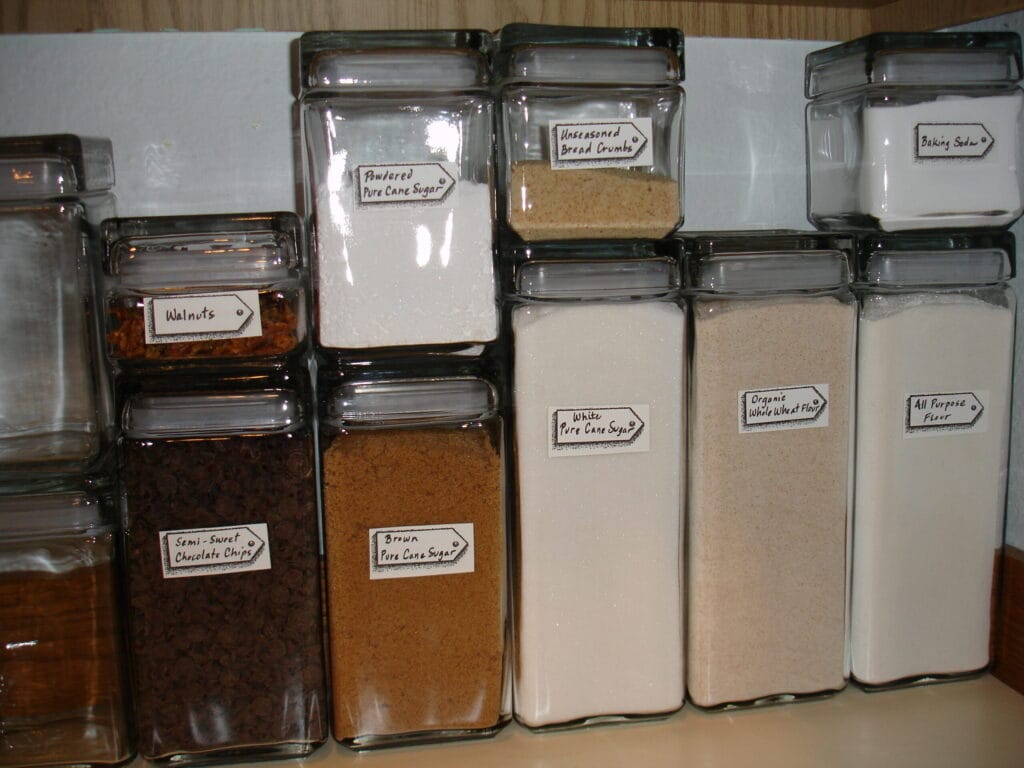
8. Create a dedicated pantry zone
Even if you do not have a walk-in pantry, one cabinet can function as a pantry zone. Group breakfast foods, snacks, dry goods, baking ingredients, or canned goods into predictable areas.
Frequently used products should be easiest to reach. Less frequently used products can occupy higher or deeper areas.
9. Give countertops a job
Counter space is working space. If it is covered permanently with appliances, containers, mail, or miscellaneous objects, the kitchen can feel smaller than it actually is.
Decide which appliances genuinely earn permanent counter space. Store occasional-use equipment in a defined cabinet or shelf when practical.
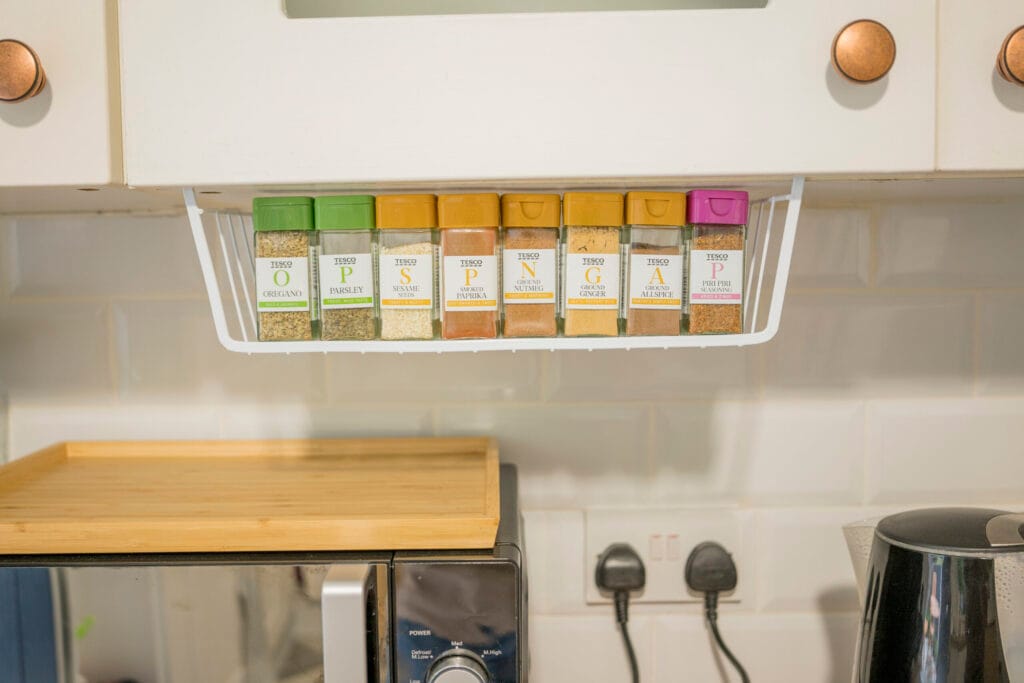
10. Use vertical wall space selectively
Rails, hooks, and shelves can help when wall space is available, especially for lightweight tools that you use often. But adding storage everywhere can make a small kitchen feel visually crowded.
Use wall storage when it improves access, not simply because an empty wall exists.
11. Organize under the sink around the plumbing
The cabinet under the kitchen sink has awkward pipes and can become a dumping ground for cleaning products. Start by removing expired or unnecessary supplies.
Use a small number of removable bins so frequently used items can be pulled forward. Keep products separated according to their purpose and follow each product’s label for safe storage. Professional organizers also recommend considering moisture and plumbing limitations before choosing under-sink storage.
12. Use narrow spaces for flat items
A narrow gap between cabinets or appliances can sometimes hold a purpose-built slide-out rack for suitable items. Before using a narrow space, make sure the rack can be removed and cleaned and that it does not interfere with doors or ventilation.
13. Make the refrigerator easier to see
Refrigerator bins can group similar foods, but visibility matters more than creating a perfectly matching collection of containers. Group foods according to how your household uses them and avoid pushing small items behind large packages.
If a refrigerator shelf repeatedly becomes difficult to manage, change the category or location rather than simply buying another bin.
14. Measure before buying anything
Measure width, depth, height, opening clearance, door swing, and nearby obstacles. Also consider whether a drawer or shelf needs to move past the proposed organizer.
Write the measurements down and keep them on your phone. This prevents buying storage products that are slightly too wide or too tall.
15. Do not fill every available space
A storage system needs breathing room. If shelves are packed completely full, putting groceries away becomes difficult and retrieving one item can disturb everything around it.
Leaving some empty capacity makes the system more forgiving and easier to maintain.
Which storage solution should you try first?
| Problem | Potential solution | What to check first |
|---|---|---|
| Items stacked too high | Shelf riser | Vertical clearance |
| Trays falling over | Vertical divider | Cabinet width and opening |
| Deep shelves hide items | Pull-out bin or tray | Depth and weight |
| Wide messy drawer | Adjustable divider | Drawer dimensions |
| Bottles disappear in corners | Turntable | Diameter and door clearance |
| Countertop is crowded | Reduce permanent countertop items | Actual appliance usage |
Common storage mistakes
- Buying first and measuring later: the wrong size can create more clutter.
- Using every inch: maximum capacity is not the same as usability.
- Creating too many categories: complicated systems are harder to maintain.
- Hiding everyday items: convenience should determine where frequently used tools live.
- Buying matching containers for everything: storage should solve a problem, not create another chore.
A simple weekend storage reset
- Choose the single storage area that causes the most frustration.
- Remove everything from that area.
- Discard or relocate items that do not belong there.
- Group what remains by use.
- Measure the available space.
- Use existing containers before buying new ones.
- Buy only the organizer that solves the remaining problem.
- Leave some empty capacity.
FAQ
How can I create more storage without remodeling?
Start with vertical space, deep-cabinet access, drawer organization, and unused cabinet-door space. These areas can often become more useful without construction.
Are kitchen organizers worth buying?
They can be, but only when they solve a recurring storage problem. Measure first and choose a product that makes access easier rather than simply adding another container.
How do I make a small kitchen look less cluttered?
Keep counters clear where possible, group similar items, give everyday objects predictable homes, and avoid filling shelves completely. Visual simplicity usually follows functional organization.
For a step-by-step decluttering approach, see our small kitchen organization guide. If the pantry is the main problem area, continue with our small pantry organization guide.
Bottom line
The best small-kitchen storage idea is the one that makes a daily task easier. Start by identifying the exact problem, remove unnecessary items, measure the available space, and then choose a simple solution. A small kitchen does not need to hold more things; it needs to make the things you already use easier to find, reach, and put away.