
A small kitchen can feel crowded even when you do not own that much. The problem is often not a lack of cabinets or containers. It is that everyday items do not have clear, convenient places to live.
The good news is that you can usually create more usable space without remodeling the kitchen or filling it with expensive organizers. The most effective approach is to reduce unnecessary items, use the space you already have more efficiently, and keep the things you use most within easy reach.
1. Start by removing what you do not use
Before buying a single organizer, empty one cabinet, drawer, or shelf at a time. Put similar items together and ask three simple questions: Do I use this? Do I have another item that does the same job? Would I notice if this disappeared?
Keep everyday essentials, move occasional-use items to less convenient storage, and set aside duplicates or broken items. Storage products cannot solve an overcrowding problem if the kitchen contains more things than the available space can reasonably hold.
2. Group items by how you use them
Instead of organizing only by object type, organize around daily routines. Keep coffee supplies together, for example, or place the cutting board, knives, and frequently used cooking tools near the main food-preparation area.
This reduces unnecessary movement and makes it easier to return things to the same place. A small kitchen works better when the layout supports the way you actually cook and clean.
3. Give the easiest spaces to your most-used items
Prime storage space should not be reserved for things you use twice a year. The easiest-to-reach drawers and shelves should hold the products you reach for every day.
Move seasonal bakeware, specialty serving pieces, and rarely used appliances toward the back of deep cabinets or onto higher shelves. This simple swap can make a small kitchen feel much larger without adding any new storage.
4. Use vertical space inside cabinets
Many kitchen cabinets have unused air above plates, bowls, mugs, or small appliances. A shelf riser can turn one tall section into two usable levels. The same principle works with stackable storage, provided the items remain easy to remove.
The goal is not to fill every inch. Leave enough clearance that you can take an item out without moving five other things first.
5. Make deep cabinets easier to access
Deep cabinets often become storage black holes. Items disappear at the back because reaching them is inconvenient.
Group similar items in simple bins or pull-out containers so you can move a whole group instead of searching through individual objects. This works particularly well for baking supplies, cleaning products, snacks, and less frequently used kitchen tools.
6. Improve the inside of cabinet doors
Cabinet doors can provide useful storage for lightweight items. Depending on the cabinet design, you may be able to use a slim rack or adhesive organizer for measuring spoons, wraps, small cleaning tools, or other compact supplies.
Measure the door and the available clearance first. An organizer that prevents the door from closing is not an organization solution.
7. Control food storage before adding more containers
Food containers are useful, but buying more containers is not automatically the answer. First match the container system to the amount of food you regularly store.
Choose a limited number of compatible sizes that stack well. When containers and lids have a consistent system, it becomes easier to see what you have and avoid creating a cabinet full of mismatched pieces.
8. Create a simple pantry zone
Even without a dedicated pantry, you can create a pantry zone inside a cabinet or on a shelf. Keep frequently used dry goods together and arrange them so the oldest items are easiest to see.
Small bins can help separate categories such as breakfast foods, baking ingredients, snacks, or packets. Clear labels are optional; the important part is that each category has a predictable home.
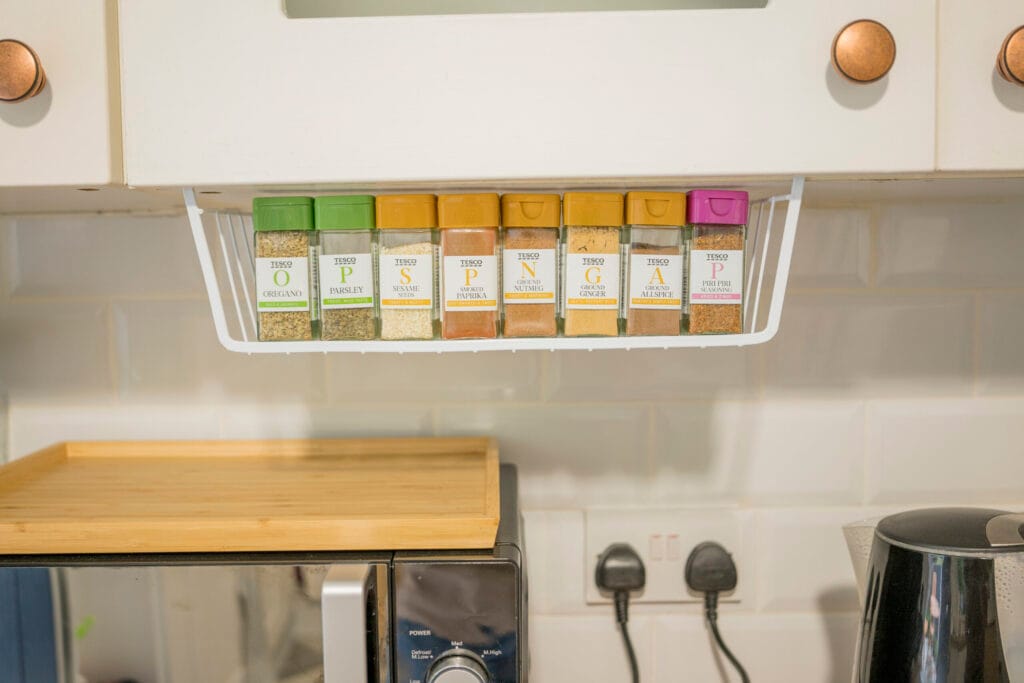
9. Stop storing everything on the countertop
Counter space is valuable in a small kitchen because it is your main work surface. If an appliance or container is permanently sitting there, ask whether it is genuinely used often enough to deserve that space.
Keep daily-use appliances accessible when practical. Store occasional-use appliances elsewhere. Even clearing one section of countertop can make the entire kitchen feel less crowded.
10. Use the refrigerator more deliberately
A crowded refrigerator can waste just as much usable space as a crowded cabinet. Group similar foods together and avoid stacking items so tightly that you cannot see what is behind them.
A small number of refrigerator bins can help keep categories together, but do not turn the refrigerator into a collection of containers. Visibility matters more than having a perfectly matching system.
11. Keep cleaning supplies together
Kitchen cleaning products are easier to manage when they have one defined storage area. Separate everyday cleaning supplies from refills and products used only occasionally.
If young children are present, cleaning chemicals should be stored according to the product label and local safety guidance, in a location that prevents unauthorized access.
12. Use the space under the sink carefully
The area under the sink is often awkward because of plumbing. Instead of forcing large containers into every available gap, use a few clearly defined zones.
Keep the items you use for daily cleaning toward the front and less frequently used supplies farther back. A small adjustable shelf or removable bin can help, but measure around the plumbing before buying anything.
13. Do not buy an organizer until you measure
This is one of the most important rules for small kitchens. Measure the width, depth, and height of the space before purchasing storage products.
Also measure the opening, not just the interior. A container can fit inside a cabinet but still fail if it cannot pass through the door opening.
14. Leave some empty space
A well-organized kitchen should not be packed completely full. Empty space makes it easier to put things away, clean surfaces, and accommodate a new item when something needs replacing.
If every shelf is filled to 100 percent, the system will probably become frustrating very quickly. Aim for a setup that is easy to maintain rather than one that looks perfect for one afternoon.
15. Create a five-minute reset
The best organization system is one you can maintain. At the end of the day, return appliances, containers, dishes, and food to their assigned places. Wipe the main work surface and deal with anything that does not belong in the kitchen.
A short daily reset is usually easier than waiting until clutter becomes a large weekend project.
What should you buy first?
If your kitchen genuinely needs additional storage, buy based on a specific problem rather than because an organizer is popular online. Useful categories can include stackable shelf risers, appropriately sized bins, drawer dividers, slim cabinet-door organizers, and pull-out storage for deep cabinets.
Before buying, check the dimensions, weight capacity, material, cleaning requirements, installation method, and whether the product leaves enough clearance for the cabinet or drawer to operate normally.
A simple small-kitchen organization plan
- Clear one cabinet or drawer.
- Remove broken, unused, and unnecessary duplicates.
- Group the remaining items by routine or category.
- Move frequently used items into the easiest locations.
- Use vertical space where it improves access.
- Measure any problem area before buying an organizer.
- Leave some empty capacity for everyday use.
- Do a five-minute reset each evening.
For another practical storage project, see our small pantry organization guide.
The bottom line
Organizing a small kitchen is less about owning clever storage products and more about making every item easy to find, use, and put away. Start by removing what you do not need, then improve the layout of the space you already have. Only after identifying a specific storage problem should you buy an organizer.
A kitchen that is slightly less full but much easier to use will usually serve you better than a kitchen packed with products designed to make it look organized.
Pingback: How to Make a Small Apartment Feel Bigger Without Remodeling
Pingback: Home Storage Solutions for Small Spaces: What Actually Works