A small pantry can work surprisingly well when every shelf has a purpose. The goal is not to make the space look like a showroom. It is to make groceries easy to see, easy to reach, and easy to put away after a shopping trip.
Professional organizers commonly recommend starting with decluttering and planning before buying storage products. Current consumer guidance also emphasizes visibility, sensible categories, accessible everyday foods, and storage systems that are realistic to maintain.
Before you organize: measure the space
Take measurements of the pantry or cabinet before buying bins, risers, turntables, or containers. Record the usable width, depth, and height of each shelf. Also measure the opening of the cabinet door if the storage area has a narrow entrance.
Pay attention to hinges, door frames, fixed shelves, pipes, and other obstructions. An organizer can fit inside a cabinet and still be unusable if it cannot pass through the opening.
Step 1: Empty one section at a time
Do not start by buying containers. Remove the contents of one shelf, drawer, or cabinet section and put similar items together on a clean surface.
Check for expired food, damaged packaging, products you no longer use, and duplicates. If you have unopened food that you know you will not use, set it aside for donation where local food-donation rules allow.
Working in sections prevents the entire kitchen from becoming unusable while you organize.
Step 2: Create zones that match real life
Choose categories based on how your household actually uses food. A small pantry might have zones for breakfast foods, baking ingredients, pasta and grains, snacks, canned foods, cooking ingredients, and backstock.
You do not need a complicated labeling system. If a category is obvious, a label may add little value. What matters is that the same category always returns to the same area.
Step 3: Put frequently used foods in the easiest locations
Eye-level shelves and the front of cabinets should generally go to foods you use often. Less frequently used items can occupy higher shelves or less convenient corners.
This is more useful than arranging everything according to appearance. A pantry is a working storage area, so convenience should come before decoration.
Step 4: Use the first-in, first-out rule
When you buy another package of an item you already have, place the older package where you will see it first. Put the newer package behind it.
This simple habit makes it easier to notice what needs to be used and reduces the chance that older products will disappear at the back of a shelf.
Step 5: Decide what deserves a container
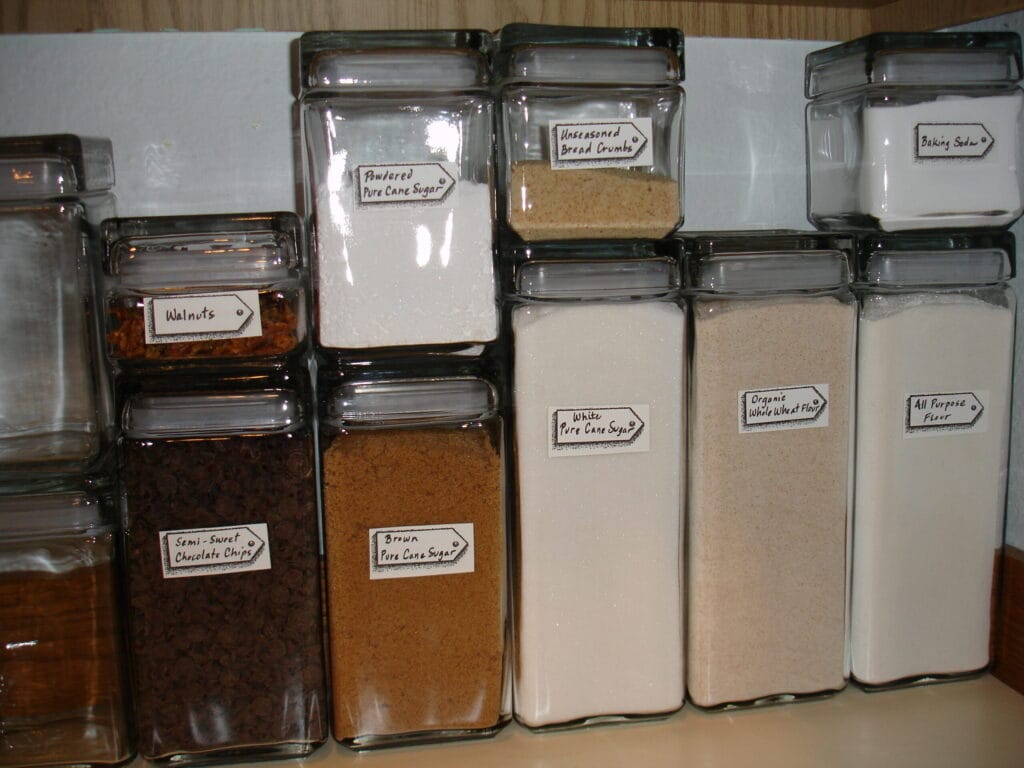
Not every pantry item needs to be transferred into a matching container. Dry goods such as rice, pasta, cereal, oats, beans, and flour can benefit from containers when they are frequently used or when their original packaging is difficult to stack.
But decanting everything can create extra work. You have to refill containers, wash them, and keep track of what is inside. Consumer Reports notes that a container system should be practical to maintain rather than chosen only because it looks attractive.
Step 6: Use bins for loose or hard-to-stack items
Bins are particularly useful for snack packets, small baking supplies, condiment bottles, or packages that tend to fall over. A bin can function like a removable drawer: pull it forward, take what you need, and return it.
Clear bins can make contents easier to identify, but opaque bins can also work when the category is obvious or labeled. The important thing is that the container improves access rather than hiding items.
Step 7: Make canned goods visible
Cans are easy to stack but can become difficult to identify when several rows are packed together. A small tiered shelf can make the back row easier to see.
Do not stack so high that cans become unstable or difficult to remove. Accessibility is more important than squeezing in one additional row.
Step 8: Handle bottles and sauces differently
Oil, vinegar, sauces, and other bottles often work better in a shallow tray, bin, or turntable than in individual containers. The goal is to keep them together while making the bottle at the back reachable.
A turntable can be particularly useful in a deep corner cabinet because rotating it brings items forward instead of requiring you to reach behind several bottles. Professional organizers frequently use this principle to improve access in deep storage areas.
Step 9: Do not waste vertical space
Look for tall gaps above cans, bowls, boxes, or short containers. A properly sized shelf riser can create a second level in an otherwise unused area.
Before buying one, check the height of the items that will sit underneath it. If you cannot comfortably remove those items, the extra shelf has made the pantry harder to use rather than better.
Step 10: Keep backstock under control
Bulk buying can save money in some situations, but only when the pantry has room for it and the products will actually be used. Create one clearly defined backstock area rather than allowing spare packages to spread across several shelves.
When that zone is full, treat it as a signal to use what you already have before buying more.
Step 11: Leave some empty space
A pantry that is filled to every available inch is difficult to maintain. Leave enough room for new groceries and for your hands to reach the items behind the front row.
Empty space is not wasted space if it makes the system easier to use.
Common pantry organization mistakes
- Buying organizers before measuring: products that do not fit become clutter themselves.
- Decanting everything: attractive containers can create unnecessary maintenance.
- Putting daily foods too high: convenience should determine shelf placement.
- Hiding everything in deep bins: storage that cannot be seen may become forgotten.
- Overfilling shelves: tightly packed storage makes putting groceries away harder.
- Creating too many categories: a system should be simple enough to remember without thinking.
A practical pantry layout for a small kitchen
If you have only one or two cabinets rather than a walk-in pantry, try this basic arrangement:
- Eye level: everyday breakfast foods, snacks, coffee, tea, or frequently used ingredients.
- Middle shelf: cooking staples such as pasta, rice, grains, sauces, and canned foods.
- Lower shelf: heavier items and larger packages.
- Upper shelf: occasional-use ingredients and small amounts of backstock.
- Door or side area: suitable lightweight items if the cabinet has enough clearance.
Adjust this arrangement around your household’s habits. The best layout is the one that reduces unnecessary reaching and searching.
How to keep the pantry organized
Organization is not a one-time project. Once a week, spend a few minutes returning misplaced items, bringing older products forward, and checking what needs to be used soon.
After grocery shopping, put new products behind existing ones whenever practical. If one category repeatedly becomes messy, change the storage method instead of repeatedly forcing the same system to work.
Do you need labels?
Labels are useful when a container is opaque, when several family members share the pantry, or when a category is not obvious. They are less useful for foods that are already easy to identify.
A simple category label such as “Baking,” “Snacks,” or “Breakfast” can be enough. There is no need to turn a small pantry into a labeling project.
FAQ
What should go at eye level in a small pantry?
Put foods you use frequently at the easiest height to reach. This usually includes breakfast items, snacks, coffee or tea, and everyday cooking staples.
Are clear pantry containers worth it?
They can be useful when they improve visibility and stacking, especially for frequently used dry goods. They are not necessary for every food and can create extra maintenance if the system is too complicated.
How often should a pantry be reorganized?
A full reorganization should not be necessary frequently if the system is practical. A short weekly reset and an occasional deeper declutter can keep the space manageable.
What is the biggest mistake when organizing a small pantry?
Trying to fit too much into too little space. The most effective system makes items visible and accessible instead of simply maximizing the number of objects stored.
If you are also trying to make the whole kitchen easier to use, see our small kitchen organization guide and small kitchen storage ideas.
Bottom line
A well-organized small pantry is built around access, visibility, and habits—not expensive containers. Start by removing what you do not need, measure the space, create a few useful zones, place everyday foods where they are easiest to reach, and buy storage products only when they solve a specific problem.